STM32 bare metal: writing a linker script and startup code from scratch
Chapters 2 and 3 (covered in the hello world post and the blinky toolchain post) relied on STM32CubeIDE’s auto-generated startup assembly and linker script. Chapter 4 of Israel Gbati’s Bare-Metal Embedded C Programming rips all of that away: you write the linker script yourself, write the startup code in C instead of assembly, and piece together enough of the C runtime for main() to actually run. (Chapter 5 builds on this by automating the build with a Makefile, and Chapter 6 rewrites the hardware access using the CMSIS standard.)
The Memory Map
Before writing any code, I confirmed the STM32F446RE’s memory layout from the reference manual:
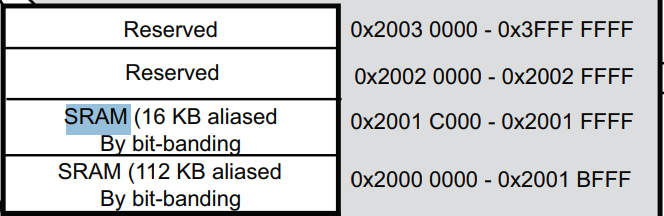
Two regions matter:
- FLASH: starts at
0x08000000, 512 KiB. Where the program lives. - SRAM: starts at
0x20000000, 128 KiB. Volatile working memory.
The Linker Script
The linker script tells the linker three things: what the entry point is, what memory exists, and which sections go where.
/* Specifying the firmware's entry point */
ENTRY(Reset_Handler)

/* Detailing available memory */
MEMORY
{
    FLASH(rx):ORIGIN =0x08000000,LENGTH =512K
    SRAM(rwx):ORIGIN =0x20000000,LENGTH =128K
}

_estack = ORIGIN(SRAM)+LENGTH(SRAM);

/* Specifying the necessary heap and stack sizes */
__max_heap_size = 0x200;
__max_stack_size = 0x400;

/* Defining output sections */
SECTIONS{
    .text :
    {
    . = ALIGN(4);
     *(.isr_vector_table) /* Merge all .isr_vector_table sections */
     *(.text)             /* Merge all .text sections */
     *(.rodata)           /* Merge all .rodata sections */
     . = ALIGN(4);
     _etext = .;          /* Global symbol: end of text section */
    }>FLASH

    .data :
    {
    . = ALIGN(4);
    _sdata = .;           /* Global symbol: start of data */
     *(.data)
     . = ALIGN(4);
    _edata = .;           /* Global symbol: end of data */
    } > SRAM AT > FLASH   /* VMA in SRAM, LMA in FLASH */

    .bss :
    {
    . = ALIGN(4);
    _sbss = .;
    *(.bss)
     . = ALIGN(4);
    _ebss = .;
    }> SRAM
}
The key parts:
ENTRY(Reset_Handler): tells the linker which symbol is the program’s entry point. The debugger uses this, and it also determines which section gets placed first.MEMORYblock: defines the two physical memory regions with their start addresses and sizes.rxmeans flash is readable and executable;rwxmeans SRAM is fully accessible._estack: initialized to the top of SRAM (0x20000000 + 128K = 0x20020000). The Cortex-M4 loads the stack pointer from the first word of the vector table on reset, so this symbol needs to be there..textsection → FLASH: code, read-only data, and critically the.isr_vector_tableall go here. The vector table must be at the very start of flash (0x08000000) because that’s where the processor looks for it on boot..datasection → SRAMAT > FLASH: this is the subtle one..datacontains initialized global/static variables. Their runtime address (VMA) is in SRAM, but they can’t live there at power-on (SRAM is volatile). TheAT > FLASHtells the linker to store the initial values at the end of flash (LMA), and the startup code copies them to SRAM beforemain()runs..bsssection → SRAM: uninitialized variables. No flash copy needed; the startup code just zeroes this region.Linker symbols (
_etext,_sdata,_edata,_sbss,_ebss): these are the boundary markers the startup code uses to know how much.datato copy and how much.bssto zero.
The Startup Code
Instead of the traditional assembly startup file, this chapter writes it in C:
#include <stdint.h>
extern uint32_t _estack;
extern uint32_t _etext;
extern uint32_t _sdata;
extern uint32_t _edata;
extern uint32_t _sbss;
extern uint32_t _ebss;

void Reset_Handler(void);
int main(void);
void NMI_Handler(void)__attribute__((weak, alias("Default_Handler")));
void HardFault_Handler(void)__attribute__((weak, alias("Default_Handler")));
void memManage_Handler(void)__attribute__((weak, alias("Default_Handler")));


uint32_t vector_table[] __attribute__((section(".isr_vector_table"))) = {
  (uint32_t)&_estack,
  (uint32_t)&Reset_Handler,
  (uint32_t)&NMI_Handler,
  (uint32_t)&HardFault_Handler,
  (uint32_t)&memManage_Handler,
};

void Default_Handler(void) {
  while (1) {

  }
}

void Reset_Handler(void) {
  // Divide by 4 (sizeof(uint32_t))
  uint32_t data_mem_size = ((uint32_t)&_edata - (uint32_t)&_sdata) / 4;
  uint32_t bss_mem_size = ((uint32_t)&_ebss - (uint32_t)&_sbss) / 4;

  uint32_t *p_src_mem = (uint32_t *)(&_etext);
  uint32_t *p_dest_mem = (uint32_t *)(&_sdata);

  for (uint32_t i = 0; i < data_mem_size; i++) {
    *p_dest_mem++ = *p_src_mem++;
  }

  p_dest_mem = (uint32_t *)(&_sbss);
  for (uint32_t i = 0; i < bss_mem_size; i++) {
    *p_dest_mem++ = 0;
  }

  main();

  while(1);
}
Three things are happening:
Vector table: placed in the
.isr_vector_tablesection so the linker script can position it at the start of flash. The first entry is the initial stack pointer value (_estack), the second isReset_Handler, and the rest are exception handlers. On reset, the Cortex-M4 reads the first two words from address0x08000000: SP and PC..datacopy:Reset_Handlercopiesdata_mem_sizewords from the end of flash (_etext) to the start of SRAM (_sdata). This is what bridges the gap between the linker’s “store initial values in flash” and the C runtime’s “initialized globals live in RAM.”.bsszeroing: fills the.bssregion with zeros. C guarantees that uninitialized static/global variables start as zero, and this is where that guarantee is fulfilled.
The __attribute__((weak, alias("Default_Handler"))) pattern means that if you don’t provide your own HardFault_Handler (etc.), it defaults to an infinite loop. Which is exactly what you want for a bare-metal fault: halt rather than run off into undefined behaviour.
Building and Flashing
Compile both files with -ffreestanding (no standard library assumptions), link with -nostdlib and the custom linker script:
arm-none-eabi-gcc -c -mcpu=cortex-m4 -mthumb -std=gnu23 main.c -o main.o -ffreestanding
arm-none-eabi-gcc -c -mcpu=cortex-m4 -mthumb -std=gnu23 stm32f446_startup.c -o stm32f446_startup.o -ffreestanding
arm-none-eabi-gcc -nostdlib -mcpu=cortex-m4 -mthumb -T stm32_ls.ld *.o -o 3_LinkerAndStartup.elf
Then inspect the ELF to verify sections landed at the right addresses:
arm-none-eabi-objdump -h 3_LinkerAndStartup.elf | head -20

# 3_LinkerAndStartup.elf:     file format elf32-littlearm
#
# Sections:
# Idx Name          Size      VMA       LMA       File off  Algn
#   0 .text         000000fc  08000000  08000000  00001000  2**2
#                   CONTENTS, ALLOC, LOAD, READONLY, CODE
#   1 .data         00000000  20000000  080000fc  00002000  2**0
#                   CONTENTS, ALLOC, LOAD, DATA
#   2 .bss          00000000  20000000  080000fc  00002000  2**0
#                   ALLOC
.text at 0x08000000 with the vector table first, .data and .bss pointing at 0x20000000. Flash via OpenOCD + GDB the same way as the previous post:
# Terminal 1
openocd -f board/st_nucleo_f4.cfg

# Terminal 2
arm-none-eabi-gdb
(gdb) target remote localhost:3333
(gdb) monitor reset init
(gdb) monitor flash write_image erase 3_LinkerAndStartup.elf
(gdb) monitor reset init
(gdb) monitor resume
Five Attempts
This did not work the first time. Or the second. Or the third, or the fourth.
Attempt 1: Typo in startup code
The startup code had _ebsss instead of _ebss. The compiler helpfully suggested the fix:
stm32f446_startup.c:33:38: error: '_ebss' undeclared (first use in this function);
   did you mean '_ebsss'?
Fixed the spelling, recompiled, linked, flashed. The LED didn’t blink. The processor was stuck in a HardFault (xPSR: 0x01000003 in the OpenOCD output).
Attempts 2-4: Vector table in the wrong place
After fixing the typo, the objdump output revealed the real problem. The .isr_vector_table section was showing up as a separate output section at 0x20000000 (SRAM), not inside .text at 0x08000000:
Idx Name               Size      VMA       LMA
  0 .text              000000e8  08000000  08000000
  1 .data              00000000  20000000  080000e8
  2 .isr_vector_table  00000014  20000000  080000e8   <-- WRONG
  3 .bss               00000000  20000014  080000fc
On reset, the Cortex-M4 reads the first words at 0x08000000, but that was just .text code, not the vector table. The processor loaded garbage into SP and PC and immediately faulted.
The root cause was a misspelled section name in the linker script. The startup code places the table in .isr_vector_table, and the linker script had a slightly different name. Since no input section matched, the linker created a new output section and placed it according to a default rule, which happened to target SRAM.
Attempt 5: Success
Once the section names matched exactly, objdump showed the clean layout:
Idx Name          Size      VMA       LMA
  0 .text         000000fc  08000000  08000000
  1 .data         00000000  20000000  080000fc
  2 .bss          00000000  20000000  080000fc
No orphan .isr_vector_table section. It was correctly merged into .text. Flashed, resumed, and the LED blinked.
What Stuck
- The linker script is a contract. The section names in your startup code must match the section names in the linker script exactly. A single character mismatch silently creates an orphan section that goes somewhere wrong.
objdump -his your best friend. Checking section addresses before flashing saves a lot of head-scratching. If the vector table isn’t at0x08000000, nothing else matters.- VMA vs LMA. The
> SRAM AT > FLASHsyntax is the linker’s way of saying “this lives in RAM at runtime, but store the initial values in flash.” The startup code bridges that gap. - Startup code in C works. The traditional approach is assembly, but for Cortex-M everything the startup needs to do (copy
.data, zero.bss, callmain) is straightforward in C. The compiler attributes (section,weak,alias) handle the parts that would normally require assembly directives.